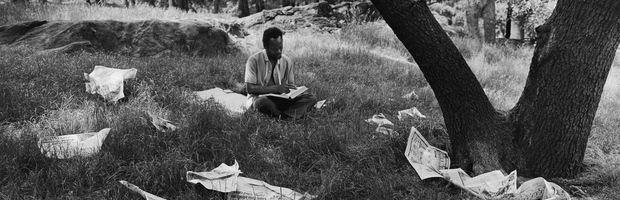


Migration Patterns
2025
£45.00
First edition of Migration Patterns by Brandon Ruffin (2025)
Specifications
- Hardback
- 255 x 200 mm
- 72 pages
- 36 images
- Poem: Siobhan by Enjoli Flynn-Ruffin
- Essay: Pendarvis Harshaw
- In a limited edition of 750 copies
About the Special edition with Prints
- Each print is in an edition of 20 numbered and stamped copies
- Accompanied by a numbered artist label, signed by Brandon Ruffin
- Printed on Hahnemühle Photo Rag Baryta 315 gsm
- Size of “Portrait of Deja” - 24 x 16 cm / 9" x 6" including 1.5 cm / 0.6" white border
- Size of “No Trespassing Bus” - 24 x 18 cm / 9" x 7" including 1.5 cm / 0.6" white border
Please note that the special edition will go up in price in increments as the edition sells through
About
Rooted in personal history and collective memory, Migration Patterns offers a powerful reflection on the enduring presence of Southern Black culture in Northern California; particularly in the cities of Oakland, San Francisco, and Ruffin’s hometown, Richmond.
The project opens with Siobhan, a poem by Enjoli Flynn-Ruffin, and is accompanied by an essay from journalist and cultural critic Pendarvis Harshaw. Together, these texts frame the book not simply as a collection of photographs, but as a lyrical meditation on legacy, migration, and the evolving meaning of home.
As a descendant of Louisianans who moved west during the Great Migration, Ruffin explores how culture is carried across distance and time. How it adapts, resists erasure, and remains encoded in language, movement, and ritual. Rather than illustrating history in a didactic sense, Migration Patterns moves with a quiet intimacy, allowing traces of Southern identity to surface through atmosphere, memory, and presence.
Woven into the work is a contemplative tension between life and death, between arrival and departure. Ruffin stands in the stillness of both birth and mourning, asking what it means not only to migrate across land, but also across spiritual thresholds. In this sense, Migration Patterns becomes not just a document of physical relocation, but a reflection on the migrations we each undergo: into being, into legacy, and eventually, into memory.
The work is especially attuned to the emotional terrain of transition. It considers what is lost and what endures when communities are displaced or transformed, and how those shifts impact one’s sense of belonging. At its heart, Migration Patterns is a reflection on lineage: on what it means to be the continuation of a story, and on the responsibility of documenting that story with care.
With this monograph, Ruffin adds a vital voice to the canon of contemporary Black photography. One that bridges past and present, personal and communal, silence and testimony.
Publisher: Setanta Books
Recently Viewed Products